
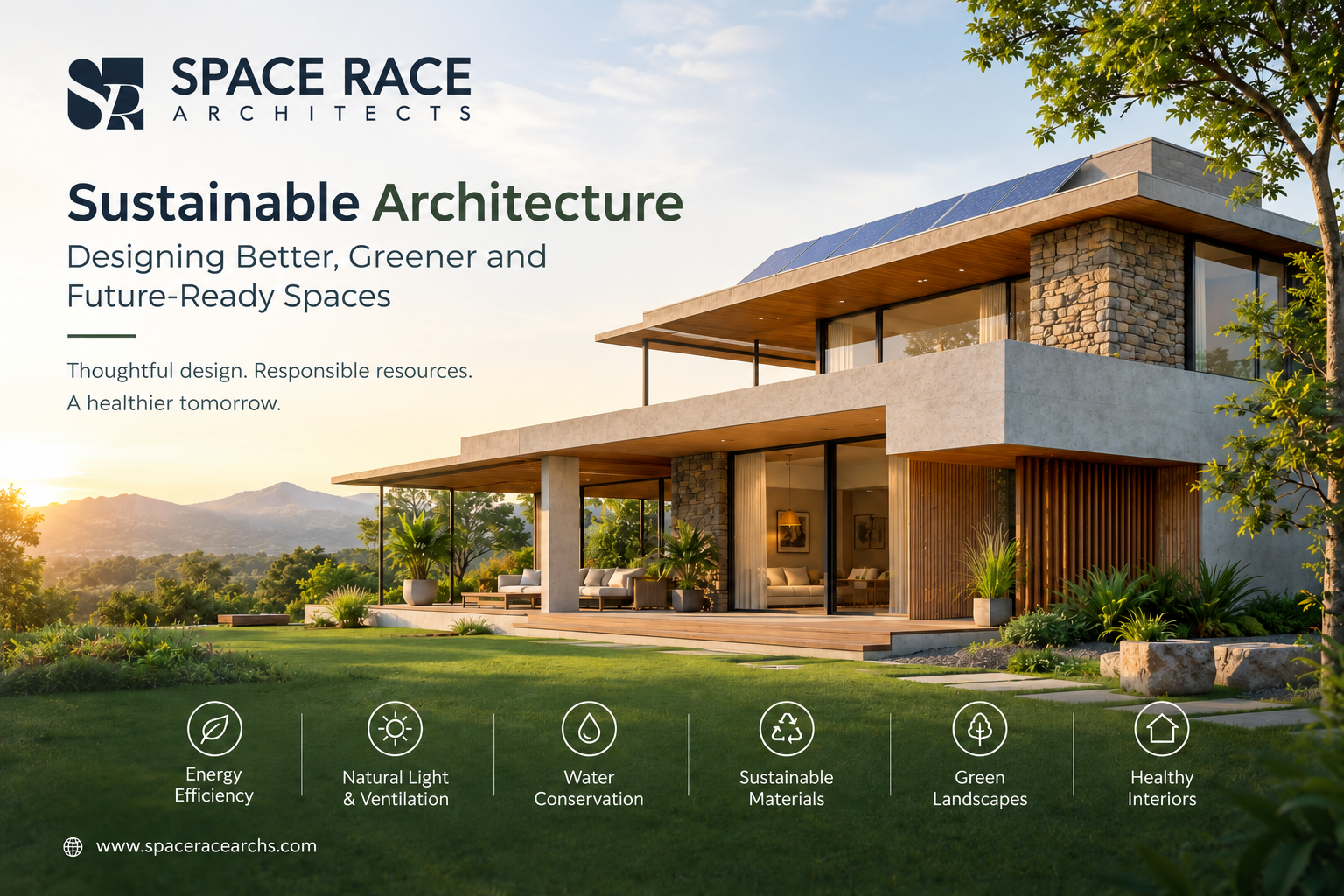
Architecture has always influenced the way people live, work, interact, and connect with their surroundings. Today, however, buildings are expected to do more than provide shelter and visual appeal. They need to respond to environmental challenges, use resources responsibly, provide healthy indoor environments, and remain efficient throughout their lifespan. This is where sustainable architecture becomes increasingly important. Rather than treating sustainability as an additional feature, sustainable architecture brings environmental responsibility into the fundamental decisions made during planning, design, construction, and operation.
At Space Race Architects, sustainable design is approached as a way of creating spaces that balance environmental responsibility, functionality, comfort, aesthetics, and long-term value. A well-planned sustainable building can reduce unnecessary energy consumption, make better use of natural resources, improve indoor comfort, and respond intelligently to its surrounding climate. The objective is not simply to create a building that looks environmentally friendly but to develop architecture that performs better throughout its life.
What Is Sustainable Architecture?
Sustainable architecture is an approach to designing and developing buildings that minimize negative environmental impact while improving the comfort, efficiency, and long-term performance of the space. It considers the relationship between a building, its occupants, its site, its materials, its energy requirements, and the surrounding environment.
A sustainable building begins with decisions made before construction even starts. Site orientation, climate conditions, building proportions, openings, shading, ventilation, materials, water management, lighting, and energy systems can all influence the overall performance of a project. When these elements are considered together, the result can be a building that requires fewer resources to operate while still offering a comfortable and attractive environment.
Sustainability does not mean that architecture has to be plain, restrictive, or disconnected from modern lifestyles. On the contrary, thoughtful sustainable architecture design can create sophisticated homes, offices, commercial spaces, institutions, and larger developments that combine contemporary aesthetics with responsible environmental performance.
Why Sustainable Architecture Matters Today
The built environment has a significant influence on energy consumption, resource use, waste generation, and environmental quality. As cities expand and lifestyles become increasingly dependent on buildings, architects need to consider how spaces can perform efficiently without compromising human comfort.
Traditional design approaches may sometimes focus heavily on appearance or initial construction requirements without considering how a building will perform over decades. Sustainable architecture takes a longer view. It considers not only how a building looks when completed but also how it consumes energy, responds to weather, uses materials, manages water, and supports its occupants over time.
For homeowners, sustainable design can contribute to improved comfort and potentially lower operational requirements. For commercial buildings, efficient planning can support better working environments and long-term operational value. For larger developments, sustainable planning can help create a stronger relationship between buildings, landscapes, infrastructure, and the surrounding community.
This makes sustainability an important part of responsible contemporary architecture rather than a temporary design trend.
The Role of Site and Climate in Sustainable Design
One of the most important principles of sustainable architecture is understanding the site before designing the building. Every location has different environmental conditions. Climate, sun path, wind direction, surrounding buildings, vegetation, topography, rainfall, and local temperatures can influence architectural decisions.
A building that works efficiently in one climate may not perform in the same way when placed somewhere else. This is why sustainable architecture should be responsive to its location rather than based on a universal formula.
Orientation can influence how much direct sunlight enters a building. Window placement can affect daylight and ventilation. Landscaping can provide shade and influence the microclimate around a structure. Building placement can also determine how effectively outdoor spaces are used throughout different seasons.
By studying the site and its environmental conditions early in the process, architects can make more informed decisions and integrate sustainability into the architecture from the beginning.
Passive Design: Using Architecture to Reduce Energy Demand
Passive design is one of the most valuable elements of sustainable architecture design because it uses the building itself to improve environmental performance. Instead of relying entirely on mechanical systems to create comfortable interiors, passive strategies attempt to work with natural environmental conditions.
Natural ventilation is an important example. Carefully positioned openings can encourage air movement and improve indoor freshness. Cross ventilation can help reduce dependence on mechanical cooling in suitable climatic conditions.
Natural daylight is another important consideration. Properly designed windows, openings, skylights, courtyards, and internal layouts can bring daylight deeper into interiors while reducing the need for artificial lighting during the day.
Solar control is equally important. Shading devices, overhangs, recessed windows, screens, vegetation, and appropriate glazing can help manage unwanted solar heat while still allowing useful daylight into the building.
These strategies demonstrate how architectural planning itself can contribute to energy efficiency. When passive principles are integrated early, they can become an inherent part of the building rather than an afterthought.
Energy-Efficient Buildings Through Intelligent Planning
Energy efficiency is a central component of sustainable architecture. The goal is to provide the required level of comfort and functionality while avoiding unnecessary energy consumption.
Building orientation, insulation, glazing, shading, lighting, ventilation, cooling systems, and equipment can all influence energy performance. An architect can coordinate these elements so that the building operates more efficiently as a complete system.
Energy-efficient lighting can reduce electricity consumption while maintaining appropriate illumination. Efficient mechanical systems can support thermal comfort with lower energy demand. Smart controls can help manage lighting and environmental systems according to occupancy and usage.
Renewable energy can also become part of a sustainable strategy where appropriate. Solar energy systems, for example, may contribute to reducing dependence on conventional electricity sources. However, renewable technology is most effective when combined with good architectural planning. Reducing unnecessary energy demand should come before simply adding more technology.
Sustainable Materials and Responsible Material Selection
Materials play an important role in the environmental performance and longevity of a building. Sustainable architecture considers not only the appearance of a material but also its durability, maintenance requirements, resource use, and suitability for the project.
Responsible material selection can involve choosing durable products, locally available materials where appropriate, recycled or recyclable materials, and finishes that support healthier indoor environments. Materials that require excessive replacement or maintenance may create additional environmental costs over the life of a building.
The selection process should also consider how materials interact with the overall architectural concept. A sustainable material should not simply be added because it has an environmental label. It should be suitable for the climate, application, performance requirements, maintenance expectations, and visual character of the project.
Good sustainable architecture design therefore looks at materials as part of a larger system rather than isolated decorative elements.
Water Conservation in Sustainable Architecture
Water is another important consideration in environmentally responsible building design. Sustainable architecture can incorporate strategies that reduce unnecessary water consumption and improve water management.
Efficient plumbing fixtures, rainwater harvesting, landscape planning, water-efficient irrigation, and appropriate drainage systems can contribute to responsible water use. Landscape design can also play a significant role by selecting vegetation that is suitable for local climatic conditions and does not require excessive irrigation.
Rainwater management is particularly valuable in larger projects. Instead of allowing rainwater to become a wasted resource or create drainage problems, appropriate planning can help collect, direct, store, or responsibly discharge water.
Water efficiency should be considered alongside architecture and landscape design so that the entire site works as a coordinated system.
Landscape and Sustainable Architecture
Buildings do not exist independently from their surroundings. The relationship between architecture and landscape can significantly influence environmental performance.
Trees and vegetation can provide shade, reduce heat around buildings, improve outdoor comfort, and contribute to biodiversity. Thoughtfully designed landscape areas can also create pleasant transition zones between indoor and outdoor spaces.
Courtyards, terraces, gardens, shaded pathways, green buffers, and planted areas can become functional parts of sustainable design. They can improve the experience of a property while also supporting environmental objectives.
For residential projects, landscape design can create comfortable outdoor areas for everyday use. In commercial and institutional developments, landscape planning can improve pedestrian movement, gathering spaces, visual quality, and the relationship between built and natural environments.
This integrated approach is an important part of effective sustainable architecture.
Healthy and Comfortable Interior Environments
Sustainability is not only about reducing environmental impact. It is also about creating better spaces for people.
A building can be considered successful when it provides appropriate daylight, ventilation, thermal comfort, acoustic quality, and healthy indoor conditions. Sustainable architecture considers these human factors alongside energy and resource efficiency.
Natural light can influence the atmosphere of an interior and reduce dependence on artificial lighting. Fresh air and appropriate ventilation can contribute to indoor comfort. Material selection can influence indoor air quality and maintenance requirements.
Good space planning also matters. A building that is efficiently organized can reduce unnecessary circulation and make better use of every square metre. This can improve functionality while avoiding excessive construction.
In this way, sustainable architecture can connect environmental performance with everyday human experience.
Sustainable Architecture and Long-Term Value
One of the strongest reasons to invest in sustainable architecture is its long-term perspective. A building is not used for only a few months after completion. It may serve its occupants for decades.
A design that considers energy use, maintenance, durability, adaptability, and future requirements can provide greater value over time. Sustainable planning can also help reduce the frequency of unnecessary alterations and replacements.
For residential architecture, this means creating homes that remain comfortable and relevant as family needs change. For commercial buildings, it can mean creating adaptable spaces that can respond to changing work patterns or business requirements.
Long-term thinking is therefore fundamental to sustainable design. The most successful buildings are not necessarily those that follow the latest visual trend but those that continue to perform effectively as circumstances change.
Technology and the Future of Sustainable Architecture
Technology is expanding the possibilities of sustainable architecture. Building performance simulations, energy modelling, smart controls, efficient building systems, and digital design tools can help architects understand how different design decisions may affect performance.
However, technology should support architectural thinking rather than replace it. A smart building still needs good orientation, appropriate planning, effective daylighting, ventilation, and sensible material choices.
The future of sustainable architecture design will likely involve an increasingly integrated relationship between architecture, engineering, landscape, technology, and environmental analysis. Buildings can become more responsive to their occupants and surroundings while using resources more efficiently.
The most successful approach will be one in which technology and fundamental architectural principles work together.
Sustainable Architecture for Modern Homes
For homeowners, sustainability can be integrated into a project without sacrificing individuality or lifestyle requirements. A sustainable home can still have a strong architectural identity, contemporary interiors, comfortable bedrooms, spacious living areas, private outdoor spaces, and carefully designed details.
The process may begin with site orientation and climate analysis and continue through planning, material selection, lighting, ventilation, water management, and landscape design.
A sustainable home should reflect the people who live in it. Rather than following a fixed template, the architecture can respond to family routines, privacy requirements, work-from-home needs, future expansion, and outdoor living preferences.
This makes sustainability a design philosophy rather than a collection of technical features.
Sustainable Architecture for Commercial and Institutional Projects
Commercial and institutional buildings have different requirements, but the principles of sustainability remain relevant. Offices, hospitality spaces, educational buildings, healthcare environments, and commercial developments can benefit from efficient planning and responsible resource use.
For these projects, sustainability can influence everything from site planning and circulation to lighting, ventilation, material selection, landscape integration, and building systems.
A well-designed sustainable commercial space can also contribute to the identity of a business. Environmental responsibility can become part of the architectural character of the building rather than being hidden behind technical systems.
Designing for Adaptability and the Future
A sustainable building should be able to respond to changing needs. Designing for adaptability can reduce the likelihood of demolition or major reconstruction in the future.
Flexible rooms, efficient structural planning, accessible services, adaptable furniture layouts, and thoughtful circulation can allow spaces to change as occupants’ needs evolve.
For residential projects, a room might initially serve as a study and later become a bedroom. For commercial projects, an open workspace might need to accommodate different teams or activities over time.
Designing for change can extend the useful life of a building and reduce the resources required for future modifications.
The Importance of an Integrated Sustainable Design Approach
Sustainability works best when it is considered throughout the entire architectural process. It should not be added after the main design has already been completed.
At Space Race Architects, the sustainable and eco-design approach considers factors such as site and climate analysis, passive design, natural light and ventilation, material and system selection, and performance optimization.
This integrated process allows different aspects of a project to support each other. Architecture, interiors, landscape, materials, lighting, services, and construction decisions can be coordinated rather than treated as separate stages.
The result is a more coherent building where sustainability becomes part of the design language and everyday experience.
Why Sustainable Architecture Is the Future of Responsible Design
The architectural industry is moving toward a more responsible understanding of what makes a building successful. Beauty and functionality remain essential, but they increasingly need to exist alongside environmental performance, resource efficiency, durability, and occupant wellbeing.
Sustainable architecture provides a framework for achieving this balance. It encourages architects and clients to think beyond the immediate construction process and consider the complete life of a building.
A sustainable project does not need to look different from contemporary architecture. It can be elegant, sophisticated, comfortable, and highly personalized. What makes it sustainable is the intelligence behind its planning and the way its design decisions respond to people, climate, materials, resources, and the future.
Creating Better Spaces Through Sustainable Architecture
Sustainable architecture is ultimately about making better decisions. It is about understanding a site before designing it, using natural conditions intelligently, reducing unnecessary energy consumption, selecting appropriate materials, managing water responsibly, integrating landscape, improving indoor comfort, and designing buildings that remain useful for many years.
When these principles are brought together, sustainability becomes much more than an environmental objective. It becomes a way to create architecture that is efficient, comfortable, resilient, and meaningful.
For homeowners, developers, businesses, and institutions looking to create future-ready spaces, sustainable architecture design offers an opportunity to combine environmental responsibility with strong architectural thinking. At Space Race Architects, the goal is to create spaces where thoughtful planning, functionality, aesthetics, and sustainability work together to deliver lasting value.
The future of architecture is not simply about building more. It is about building better. Sustainable architecture provides the opportunity to create spaces that respect their surroundings, support the people who use them, and remain valuable for generations to come.