
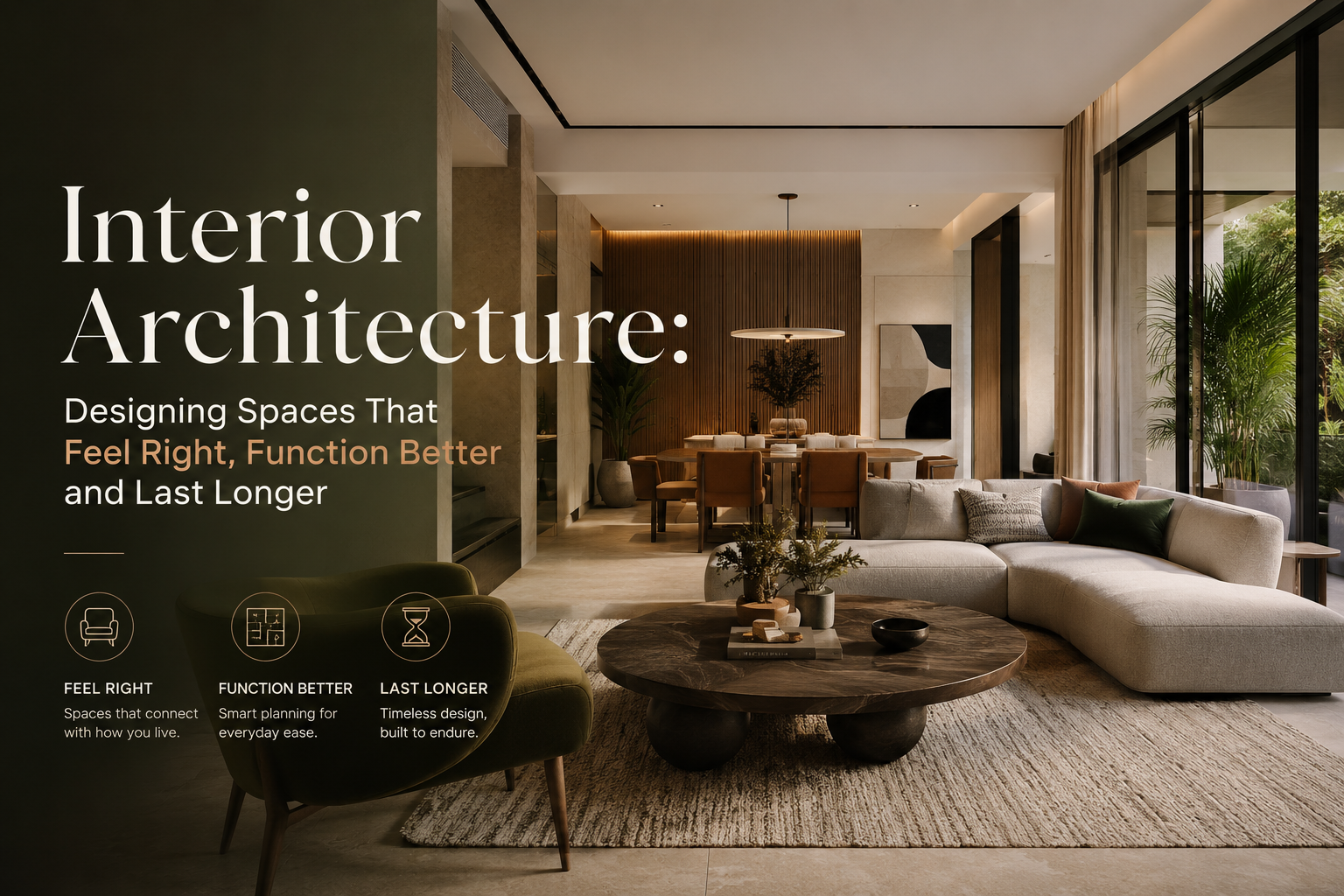
Interior architecture is not just about decorating a finished space. It is the discipline of shaping the inside of a building with the same seriousness as its structure, façade and site planning. It studies how people move, sit, gather, work, pray, rest and experience a space every day.
For a home, interior architecture decides whether the family feels connected or isolated. For an office, it decides whether the space supports focus or creates chaos. For a hotel, it influences how guests feel from the first step inside. For a religious space, it defines silence, movement, devotion and collective experience.
This is where the work of Space Race Architects becomes relevant. The studio brings architecture and interiors together from the beginning, so planning, structure and detailing evolve as one process, not as separate layers added later. Space Race works across homes, hotels, institutions, workplaces and public buildings, with a focus on clarity in design and control in execution.
What Is Interior Architecture?
Interior architecture is the planning and design of interior spaces in relation to the building’s structure, purpose and user experience. It deals with walls, openings, ceiling heights, circulation, built-in furniture, material transitions, lighting, services, acoustics and spatial flow.
Interior design often focuses on styling, furniture, colours and décor. Interior architecture goes deeper. It asks sharper questions.
Where should the staircase sit?
How does natural light enter the space?
Which wall needs storage and which wall should remain visually open?
How will the ceiling hide services without reducing the sense of height?
Where should the worship area, dining space, informal seating, washroom, kitchen or transition lobby be placed?
A good interior architecture plan reduces visual clutter, improves daily function and creates spaces that feel intentional. It ensures that beauty does not become a burden and practicality does not make the space dull.
Why Interior Architecture Matters in Modern Indian Projects
Modern Indian homes and institutions have become more complex. Families want openness, privacy, luxury, storage, vastu alignment, natural light, formal areas, informal zones, guest spaces and easy maintenance. Commercial and public projects need footfall planning, durability, safety, brand identity and operational logic.
Without strong interior architecture, even an expensive project can fail in daily use.
A large villa can feel cramped if circulation is weak.
A premium office can look impressive but perform poorly if acoustics are ignored.
A religious building can look grand but feel uncomfortable if crowd movement is not planned.
A luxury home can lose its value if lighting, storage and services are treated as afterthoughts.
Interior architecture protects the project from these mistakes. It connects the client’s lifestyle with the building’s physical logic.
Space Race Architects’ service approach reflects this thinking. Their services page states that they offer architectural design services from concept through construction, along with interior design and space planning. The studio describes interiors as functional, beautiful, directional and supportive of the building’s purpose and people.
The Core Elements of Strong Interior Architecture
1. Spatial Planning
Every successful interior begins with planning. Before finishes, furniture or styling, the layout must work.
In a residence, spatial planning defines how public and private areas are separated. It decides how guests move without disturbing family zones. It gives bedrooms privacy, kitchens efficiency and living areas the right relationship with landscape or courtyards.
In institutional projects, planning becomes even more critical. Entry, waiting, gathering, circulation, washrooms, service areas and emergency movement must all work together. The space should not only look composed in photographs. It should function under real pressure.
2. Light and Ventilation
Interior architecture controls how natural light enters and moves through a building. The placement of windows, skylights, double-height spaces, courtyards and internal openings directly affects comfort.
Good daylight reduces dependence on artificial lighting and makes interiors feel healthier. Ventilation helps the building breathe. In Indian climate conditions, this is not optional. It is a key part of long-term comfort.
A room with expensive finishes but poor light will still feel dead. A simple room with good proportions, cross ventilation and controlled daylight can feel premium without excessive spending.
3. Material Logic
Materials should not be selected only because they look good in samples. They must make sense for the space.
A floor material in a high-footfall area should be durable. A wall finish near water or dust exposure should be easy to maintain. A worship space may need materials that support calmness and acoustic softness. A luxury home may need a balance between statement surfaces and practical finishes.
Interior architecture makes material decisions strategic. It uses stone, wood, metal, glass, plaster, fabric and lighting in a way that supports the function of each area.
4. Movement and Experience
People rarely experience a building from one fixed angle. They move through it. They enter, pause, turn, climb, look up, sit down and cross thresholds.
Interior architecture designs this journey.
A narrow passage can become a meaningful transition. A staircase can become the anchor of a home. A lobby can create the first moment of arrival. A courtyard can become the emotional centre of the project.
This is especially important in luxury residential and spiritual architecture, where emotion and memory matter as much as utility.
Gurudwara Design and Waterfall House: Two Different Lessons in Spatial Experience
The secondary keyword “gurudwara design and waterfall house” may sound like two separate subjects, but both reveal an important point about architecture: spaces are remembered when they are built around experience, not decoration.
A gurudwara design must respect devotion, community, movement and humility. It is not only about creating a beautiful religious structure. It must support sangat, prayer, langar movement, entry flow, shoe storage, washing areas, accessibility, ventilation and the sanctity of the main prayer hall.
The planning must allow people to enter calmly, move respectfully and gather without confusion. The design language may use traditional forms, arches, domes, white surfaces, warm lighting or carved details, but the core purpose remains spiritual order.
Space Race Architects’ portfolio listing includes Gurudwara Nirmal Kutiya under gurudwara work, showing the studio’s involvement in religious and institutional design typologies.
The Waterfall House, on the other hand, is a residential project that uses nature as a design driver. Space Race describes the house as a modern urban sanctuary for the Vashisht family in Jalandhar, Punjab. The façade is inspired by rocky landscapes and snow-capped Himalayan mountains, while dual waterfalls mark the dual entrances into the house.
Both project types carry different functions, but the design thinking overlaps. In both, the entrance matters. Movement matters. Material expression matters. The emotional first impression matters.
In gurudwara design, the arrival should prepare the mind for stillness.
In Waterfall House, the arrival creates a sensory threshold through water, landscape and sculptural form.
That is the real value of interior architecture. It does not treat the inside as separate from the outside. It builds a complete spatial narrative.
Interior Architecture in Residential Villas
Luxury homes need more than impressive elevations. A residence must support everyday life for years. Interior architecture helps translate lifestyle into planning.
For villas and large residences, the key concerns are:
formal and informal zoning
privacy between family and guest areas
clear kitchen and service movement
double-height or courtyard planning
bedroom privacy
washroom detailing
storage integration
lighting scenes
maintenance access
landscape connection
material continuity
In many homes, the problem begins when architecture and interiors are handled separately. The building gets completed first, then the interiors are forced into the structure. This often leads to awkward furniture placement, false ceiling compromises, exposed services, weak lighting and poor storage.
When interior architecture starts early, these problems reduce. Wall thickness, window placement, electrical points, ceiling drops, air-conditioning, furniture sizes and material junctions can be coordinated before execution.
This saves time, money and design quality.
Interior Architecture in Spiritual and Institutional Spaces
Spiritual spaces require a different level of sensitivity. A gurudwara, temple, meditation centre or community prayer hall cannot be designed only through aesthetics. It must respect ritual, accessibility, congregation size, acoustics, light, movement and maintenance.
For gurudwara design, the planning must consider:
clear entry sequence
shoe deposit and washing areas
barrier-free access
main prayer hall proportions
placement of Guru Granth Sahib
circulation for devotees
langar hall movement
natural ventilation
crowd control during peak gatherings
durable materials
easy cleaning and long-term maintenance
A religious space should feel peaceful even when it is full of people. That is a planning challenge, not a styling challenge.
Interior architecture helps create that balance. It ensures that devotion is supported by order, comfort and clarity.
Interior Architecture and Sustainability
Sustainability in interior architecture is not only about using eco-friendly materials. It also means designing spaces that last longer, consume fewer resources and avoid unnecessary demolition or replacement.
A well-planned interior reduces waste because fewer changes are needed later. Durable materials reduce repair cycles. Good daylight reduces energy consumption. Ventilation improves comfort. Flexible planning allows a space to adapt over time.
Space Race Architects’ brand values mention sustainability and responsibility, with an emphasis on environmental awareness, optimized resources and future-ready spaces.
For modern projects, this matters. Clients are increasingly aware that good design should not only look premium on day one. It should perform well after five, ten and twenty years.
Why Clients Should Involve Architects Early for Interiors
Many clients delay interior decisions until construction is almost complete. This is one of the most expensive mistakes in a project.
By that stage, major structural and service decisions are already locked. Changing layouts becomes difficult. Lighting points may not match furniture placement. Ceiling heights may be compromised. AC ducts, plumbing lines and electrical routes may interrupt the design.
Early interior architecture solves this.
It allows the architect to plan the building and interiors together. The result is cleaner execution, fewer conflicts and a more refined final space.
For example, in a luxury villa, the placement of a bed should influence window height, switchboard location, wall paneling and lighting. In a gurudwara, the prayer hall proportions should influence structure, ceiling design, acoustics and entry movement. In a project like Waterfall House, the sensory experience of arrival through water and landscape must connect with the interior journey.
This level of integration cannot happen through decoration alone.
How Space Race Architects Approach Interior Architecture
Space Race Architects works with a design language where architecture and interiors are connected from the beginning. Their practice covers residential, commercial, office, hotel, cultural, educational and health institutions.
This makes their interior architecture approach broader than surface styling. The same thinking that shapes a façade also informs the interior experience. The same planning logic that organizes a building also guides furniture, lighting, ceiling, materials and circulation.
For clients, this creates a more accountable process. Instead of separate teams working in isolation, the project develops with a unified design direction.
This is especially useful for clients building:
luxury residences
farmhouses
villas
hotels
restaurants
offices
religious buildings
community spaces
educational institutions
healthcare environments
Each typology needs a different planning response. A home needs intimacy. A hotel needs hospitality flow. A restaurant needs atmosphere and operational efficiency. A gurudwara needs humility, order and spiritual calm. A public building needs accessibility and durability.
Interior architecture adapts the design process to each use case.
Common Interior Architecture Mistakes to Avoid
The first mistake is treating interiors as an afterthought. Once the structure is complete, the interior team has limited control.
The second mistake is overdesigning. Too many materials, patterns and statement elements can make a space feel heavy.
The third mistake is ignoring storage. A beautiful home without storage becomes cluttered quickly.
The fourth mistake is poor lighting. One central light or generic ceiling lights cannot support different moods and functions.
The fifth mistake is not planning maintenance. AC access, plumbing shafts, electrical panels and cleaning access must be designed carefully.
The sixth mistake is copying trends. A design that looks good online may not suit the client’s lifestyle, site, budget or climate.
Good interior architecture avoids these errors by building the design around real use.
The Future of Interior Architecture in India
Interior architecture in India is moving toward integrated, experience-led design. Clients no longer want spaces that only photograph well. They want homes that work better, offices that support productivity, restaurants that create memory and spiritual spaces that feel peaceful.
The future will favour architects and studios who can combine planning, material intelligence, technology, sustainability and emotional design.
For cities like Jalandhar, Chandigarh, Amritsar, Ludhiana and other growing urban centres, this shift is already visible. Clients are investing in homes, institutions and commercial spaces that need stronger design thinking from the first stage.
Interior architecture will play a central role in this shift.
It will decide how buildings feel from inside.
It will decide whether luxury is practical or only visual.
It will decide whether spiritual spaces are calm or chaotic.
It will decide whether homes age gracefully or become outdated quickly.
Conclusion
Interior architecture is the bridge between structure and experience. It brings together planning, light, materials, movement, services and emotion. It makes spaces more usable, more beautiful and more meaningful.
For Space Race Architects, this approach fits naturally into a practice that works across architecture, interiors, residences, institutions and public spaces. From gurudwara design to Waterfall House, the core idea remains the same: a space should not only be seen. It should be experienced with clarity, purpose and emotion.
When architecture and interiors are planned together, the result is stronger. The building works better. The interiors feel more connected. The client gets a space that is not just designed for today, but built for long-term value.
FAQs
What is interior architecture?
Interior architecture is the design of interior spaces in connection with the building’s structure, planning, services and user experience. It goes beyond decoration and focuses on how a space functions and feels.
How is interior architecture different from interior design?
Interior design often focuses on furniture, styling, colours and décor. Interior architecture includes spatial planning, circulation, lighting, ceiling design, built-in elements, material logic and coordination with the building structure.
Why is interior architecture important for luxury homes?
It ensures that the home is not only visually premium but also practical, comfortable, private, well-lit, well-ventilated and easy to maintain.
What should be considered in gurudwara design?
A strong gurudwara design should consider entry flow, prayer hall proportions, accessibility, sangat movement, langar planning, ventilation, acoustics, durability and spiritual calm.
Why should interiors be planned early in a project?
Early planning prevents costly changes later. It helps coordinate structure, lighting, furniture, services, ceiling heights, storage and material detailing from the beginning.